Every EU battery needs a passport & QR.
The regulation splits into two dates. From 18 August 2026, every battery on the EU market — including a blister pack of AAs — must carry the printed Article 13 label (manufacturer, chemistry, capacity, hazardous substances, crossed-out wheelie bin). From 18 February 2027, the same battery must also carry a QR code under Article 13(6); on the same date, industrial (>2 kWh), LMT and EV cells need the full Article 77 Battery Passport (the "Battery DPP") behind that QR. SmartLinks delivers all of it, on the same digital twin.
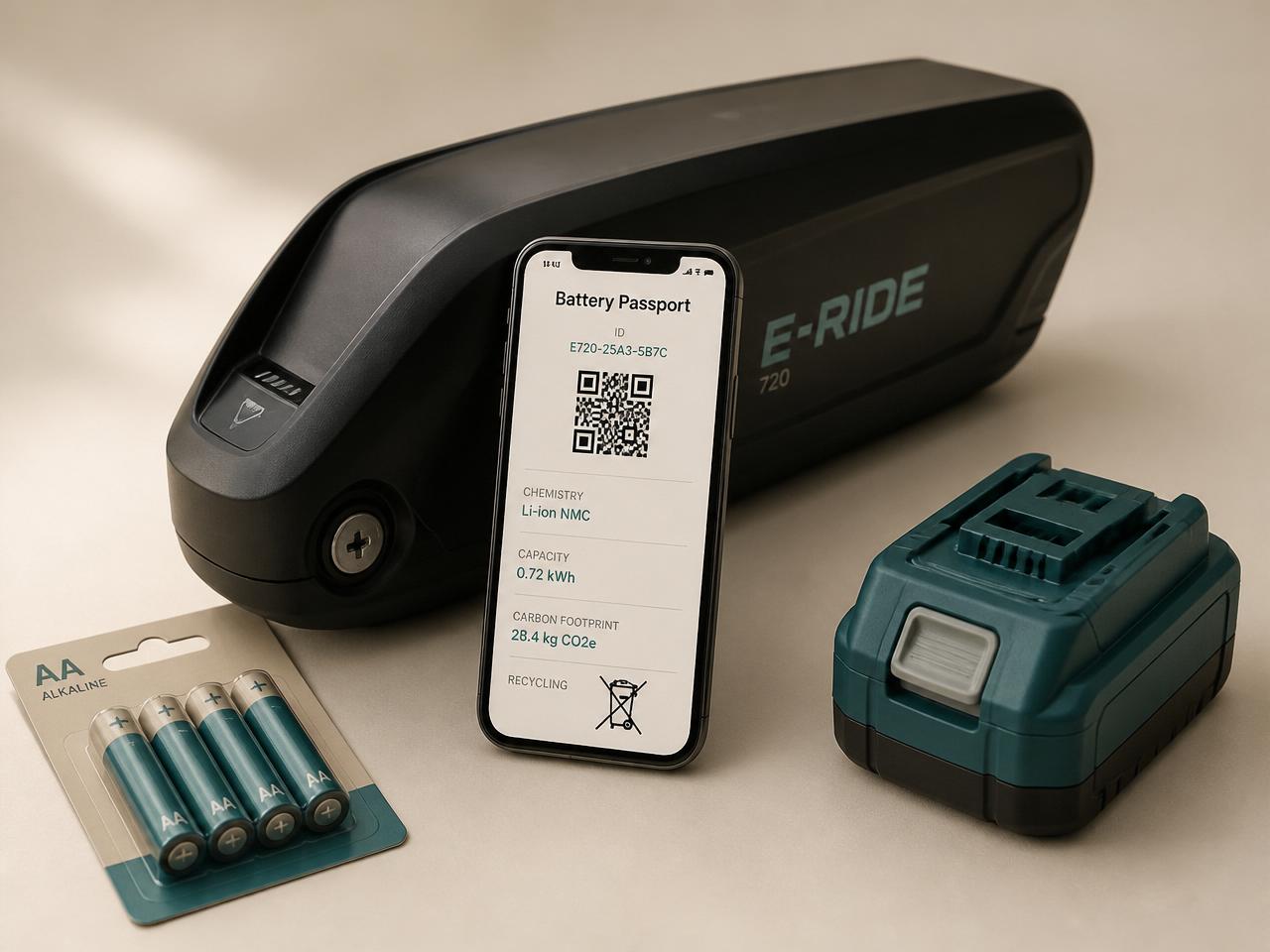
August 2026 printed label · February 2027 QR + full passport
The printed Article 13 label is mandatory from 18 August 2026. The Article 13(6) QR code follows on 18 February 2027 — same date as the full Article 77 passport for industrial >2 kWh, LMT (e-bikes, e-scooters) and EV cells. SmartLinks treats all three as the same data object — set up the record once and the platform serves the right view to consumers, recyclers and regulators.
Printed Article 13 label
QR code (Article 13(6))
Full battery passport
Everything Annex VI asks for — issued, hosted and version-controlled.
We turn the regulation into a structured record: chemistry, weight, capacity, hazardous substances, separate-collection symbol, manufacturer details, EPR registration numbers per Member State, recycled-content percentages, carbon footprint and the Article 11 removability declaration.
Annex VI printed label
Compliant print-ready artwork — wheelie bin symbol, chemistry, Cd/Pb/Hg call-outs, CE mark and the QR placed exactly where the regulation expects it.
SVG + PDF export, per SKU or per batch.
QR-linked record
One scan returns the consumer view, the operator view, the recycler view and the regulator view — role-aware, no logins for public data.
GS1 Digital Link resolver, batch- or unit-level.
EPR & take-back
Per-Member-State producer registration numbers stored against the record. Nearest collection point surfaced on every scan.
27 jurisdictions, one source of truth.
Carbon footprint
Per-SKU CFP value with the underlying PEF dataset attached as a verifiable attestation. Performance class and threshold once published.
EV from 2025, industrial 2026, LMT 2028, portables ~2030.
Recycled content
Cobalt, lithium, nickel and lead percentages held against the proof, machine-readable for procurement, regulators and disclosure indices.
Thresholds phasing 2027–2031.
State-of-health & due diligence
For industrial, LMT and EV: SoH/SoC writes back from the field, raw-material due-diligence dossier attached as evidence.
Required for the full Article 77 passport.
Five product profiles —one compliance pattern.
The regulation scopes obligations by battery category. We've mapped the typical product profile we see at each tier so you can find yours quickly.
Portable primary cells
AA, AAA, 9V, coin and button cells sold in blister packs.
Cordless tool & appliance packs
Power tool batteries, robot vacuum and cordless appliance packs, typically <2 kWh.
Light means of transport (LMT)
E-bikes, e-scooters, e-mopeds — any vehicle <750 W wheel power.
Industrial >2 kWh
BESS, telecoms backup, forklift and industrial battery packs above 2 kWh.
EV traction
Battery electric and plug-in hybrid vehicle traction packs.
Own-label & importer
Supermarket-brand AAs, white-label power tool packs, BESS importers.
What the regulation asks — what SmartLinks delivers
Every Annex VI and Article 77 requirement maps to a capability already running on the SmartLinks platform. You configure the data; we handle the label, the QR target, the role-based views and the audit trail.
Phasing reflects current EU Battery Regulation 2023/1542 interpretation. Member-state implementing acts and CEN/CENELEC standards (prEN 18222 et al.) continue to land through 2025–2026 — your record is versioned so updates land without reprinting.
From spreadsheet to passport in days, not quarters.
The same digital twin platform that runs SmartLinks Hub, the EU DPP and GS1 Digital Link resolver underpins the battery record. You bring the data; we generate the label, host the record and serve the QR target.
1. Set up the battery profile
Pick the category, declare chemistry, capacity, weight and hazardous substances. The platform shows you exactly which fields the regulation requires for that profile.
Category-aware schema · EPR registry per market · CFP & recycled content.
2. Generate label & QR
Annex VI-compliant artwork drops out as print-ready SVG and PDF. The QR resolves to a role-aware record — batch- or unit-level depending on the category.
Print-ready SVG + PDF · GS1 Digital Link target · role-aware views.
3. Keep it live
Field updates, SoH telemetry, second-life routing and end-of-life hand-off all write back to the same record — for the full ten-year retention window the regulation expects.
SoH / SoC write-back · take-back routing · versioned audit trail.
One platform , every overlap.
Most battery-bearing products carry obligations under more than one regulation. A cordless drill has an Electronics DPP (ESPR) and a battery label (Battery Regulation). An e-bike has both, plus an LMT passport. SmartLinks handles the overlap so you don't end up with three vendors and three QR codes.
GS1 Digital Link
One QR per product, multiple endpoints, indefinitely versioned.
EU DPP & ESPR
Furniture, textiles, electronics, batteries — same record, different views.
Authenticity & anti-counterfeit
Cryptographic proofs for high-value packs and EV cells.
Owner & fleet accounts
Battery registration, service records, recall reach — without rebuilding CRM.
Battery Passport & EU Battery Regulation — the questions we hear every week
Does this really apply to a pack of AA batteries?+
Yes. The August 2026 labelling and QR requirement under Article 13 and Annex VI applies to every battery placed on the EU market — portable primary cells included. The full Article 77 passport is narrower (industrial >2 kWh, LMT, EV), but the printed label and QR target are universal. Batch-level QR is permitted for portables, so one QR per SKU/batch is enough.
Is there a grace period?+
Article 96 lets batteries placed on the market before 18 August 2026 sell through without the new label. Given primary cells have multi-year shelf lives, unlabelled stock will be on EU shelves into 2027–2028. The Commission's implementing act for the QR data format and CEN/CENELEC standards (prEN 18222 et al.) are still landing, so enforcement will be soft initially — but the legal deadline is fixed.
We sell in the UK only. Does this affect us?+
GB has not onshored Regulation 2023/1542 and still operates under the 2009 Batteries Regulations. Northern Ireland follows the EU regime under the Windsor Framework. If you sell into the EU — or into NI — you need to comply. Most UK brands also align voluntarily because retailers, marketplaces and Scope-3 reporting frameworks already ask for the data.
Does a cordless drill need two passports — one for the battery and one for the tool?+
Effectively, yes. The drill itself falls under ESPR-driven Electronics DPP rules; the removable battery pack falls under the Battery Regulation. SmartLinks treats both as views over the same digital twin, so the QR on the tool and the QR on the pack resolve to the right record without duplicating data.
Can we use one QR for a whole batch instead of per cell?+
For portable primary cells (AA/AAA/coin) and for non-rechargeable categories, batch-level QR is permitted and standard. For industrial >2 kWh, LMT and EV the regulation requires unique per-unit identifiers — one QR per battery. The platform handles both modes from the same configuration.
What if our supplier data isn't ready yet?+
We model the record now with placeholders and version it as supplier attestations arrive. The QR resolver returns the most recent verified version, so you can ship compliant labels in stages rather than waiting for a perfect dataset.
Further reading
- Battery Passport overview — the pillar page: what the passport is, who needs one, and the SME vs enterprise split.
- Battery Compliance Deep Dive — eight-tab walkthrough of Article 11, the QR label, CFP phasing, EPR, worked examples and the playbook by company profile.
- Battery Passport guide — the regulation explained with the five Article 3 categories and what each must carry.
- Does your cordless drill need two DPPs? — battery vs electronics passport, and what to do when the battery is built in.
- DPP Timeline 2026–2032 — every regulation, deadline and category in one view.
- Electronics & e-waste DPP guide — for the host appliance side of the overlap.
- Platform DPP — the cradle-to-grave platform that underpins every category of passport.
Official sources
- Regulation (EU) 2023/1542 — full text (EUR-Lex).
- European Commission — Batteries and accumulators.
- Global Battery Alliance — Battery Passport (industry reference standard).
Get your Battery Passport ready before the 18 August 2026 deadline.
We'll show you the live battery record, the print-ready Annex VI label and the QR resolver in a 30-minute working session — using one of your own SKUs.